
Mold Inspection and Testing in Albany NY
You smell something musty, but you cannot see anything. Or maybe you can see something, a suspicious stain, a patch that might be mold or might be dirt, and you have no idea which. This is the worst stage of a mold problem, the not knowing stage. Your imagination fills in the blanks, and it never fills them in kindly.
- Licensed and Insured Network
- Same-Day Service
- Free Estimates
4.9/5
Average customer rating
Licensed NY pros
Connected with independent NYS licensed mold assessors and remediators.
Upfront pricing
Written quotes in ranges you can understand. No surprise add-ons.
Fast response
Same-day and next-day appointments across the Capital Region.
Done right
Containment, HEPA filtration, and post-job verification on every project.
Here is how you get answers. Mold Removal Albany is a free referral service connecting you with independent, licensed mold assessors in the Albany area. We do not inspect or test ourselves, and we do not remediate either. We match you with a licensed professional who will tell you what is actually going on, in plain language, so you can make decisions based on facts instead of fear.
You Smell It, But You Cannot See It. Now What.
Here is a scenario we hear constantly. Everything looks fine. No visible patches, no obvious water damage. But there is a smell, musty, earthy, wrong, and it is always strongest in the same spot. Or maybe the kids keep getting congested at home and fine everywhere else. You start wondering, and wondering is exhausting.
This is exactly what mold inspections are for. Not every mold problem announces itself with a dramatic black patch. Plenty of growth hides behind drywall, under flooring, inside wall cavities, or up in the attic. A trained assessor knows where to look, what to measure, and how to tell the difference between a real problem and a harmless stain.
And here is the thing. An inspection either finds something, in which case you now have a plan, or it finds nothing, in which case you get to stop worrying. Both outcomes are worth the call. Uncertainty is the most expensive part of this whole process, because it costs you sleep.
We Do Not Test. We Do Not Remediate. We Connect.
Let us be crystal clear about our role, because it actually protects you. Mold Removal Albany is a free referral service. We do not perform inspections, we do not take samples, and we do not do remediation work. We connect you with independent, licensed mold assessors in the Albany area, and separately, with licensed remediators when work is needed.
That separation is not just our policy. Under New York State Article 32, the company that assesses or tests for mold cannot be the same one that remediates it on covered projects. It is the law, and it exists so the person telling you how bad the problem is has no financial interest in making it sound worse. We build every referral around that principle.
So when we connect you with an assessor, you are getting an independent professional whose only job is to find the truth. Not to sell you a remediation package. Just the facts, documented, so whatever comes next is based on reality.
What a Real Mold Inspection Actually Involves
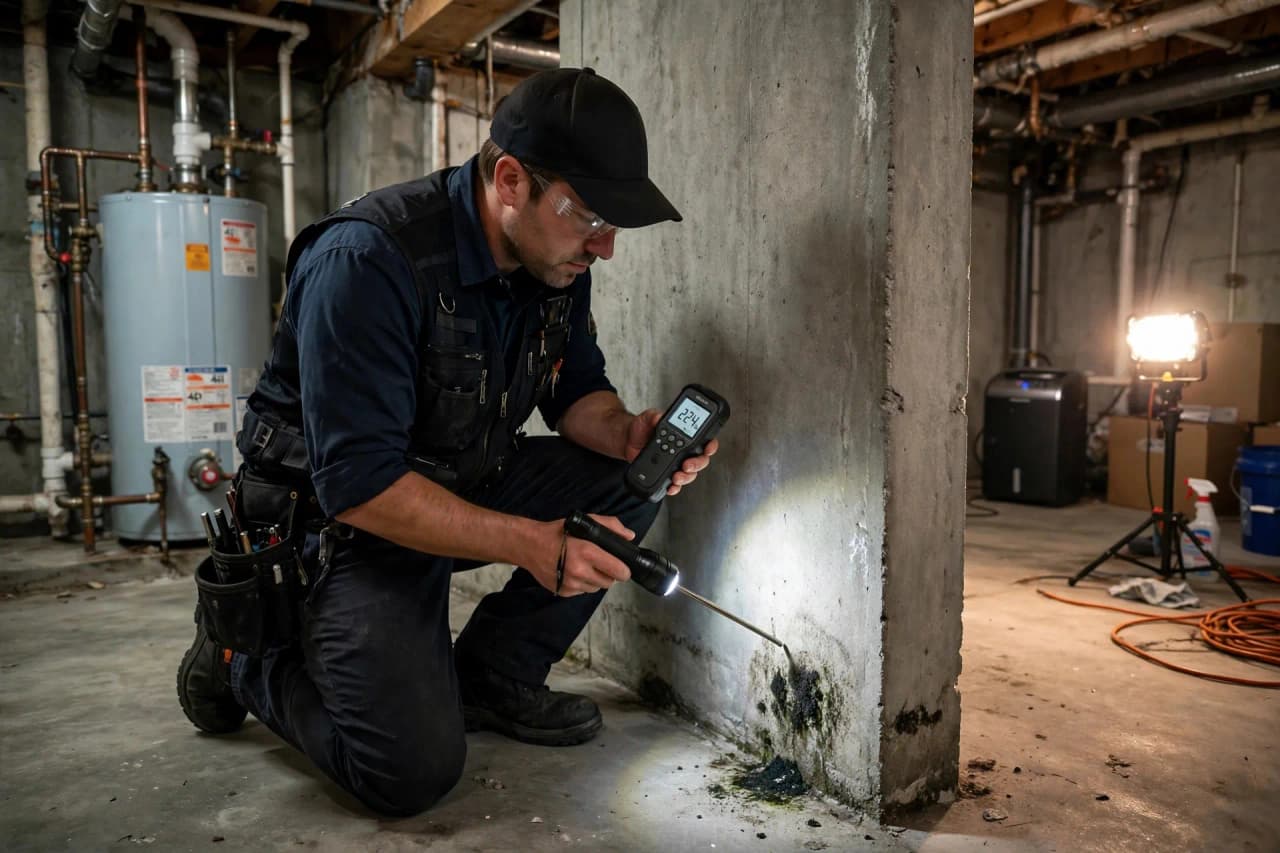
A proper mold inspection is part detective work, part science. The assessor starts with your story, what you have seen, smelled, or experienced, and any history of leaks, flooding, or water damage. Then comes the physical walkthrough, room by room, with attention to the usual suspects, basements, bathrooms, attics, crawl spaces, and anywhere plumbing runs through walls.
They are looking for visible growth, water staining, and moisture intrusion, but also measuring what your eyes cannot see. Moisture meters check walls, floors, and framing for elevated readings. Thermal imaging cameras reveal cold damp areas hiding behind finished surfaces. Humidity readings tell them whether the indoor environment is feeding mold growth.
Testing enters the picture when it adds useful information. Air sampling compares indoor spore levels to outdoor baseline levels. Surface sampling identifies what is growing on a specific spot. Wall cavity sampling can confirm hidden growth without tearing your house apart. A good assessor does not test everything in sight, they test where the results will actually change the plan.
Your Inspection, Step by Step
If you have never had a mold inspection, here is what to expect when the assessor arrives. No drama, no hazmat theatrics, just a methodical professional doing thorough work.
- Interview. The assessor asks about symptoms you have noticed, smells, visible spots, water history, and any health concerns in the household. The more you share, the better they can target the inspection.
- Visual walkthrough. Every accessible area gets examined, with extra attention to basements, bathrooms, kitchens, attics, and around windows, plumbing, and HVAC components.
- Moisture mapping. Meters and thermal imaging identify damp areas, including hidden ones. This often reveals the water source, which matters more than the mold itself.
- Sampling, when warranted. Air cassettes, surface swabs or tape lifts, and cavity samples get collected following proper protocols and sent to an accredited lab.
- Written report. You receive documented findings, lab results when testing was done, moisture readings, photos, and clear recommendations. This report becomes your roadmap, whether the next step is remediation, minor repairs, or simply monitoring.
The Tools Behind a Thorough Inspection
Anyone can walk through a house and point at a stain. A licensed assessor brings instruments that turn hunches into data, and that data is what separates a real inspection from an expensive guess.
Pin and pinless moisture meters measure water content in wood, drywall, and other building materials, revealing dampness your eyes cannot catch. Thermal imaging cameras show temperature differences that indicate moisture behind walls or under floors. Hygrometers measure indoor humidity, because sustained high humidity alone can feed mold growth even without a leak.
For testing, assessors use calibrated air sampling pumps with spore trap cassettes, surface sampling kits, and sometimes borescopes, tiny cameras that peek inside wall cavities through a small hole. Samples go to accredited laboratories, not a DIY petri dish kit from the internet. The lab identifies mold types and concentrations, and the assessor interprets what those results actually mean for your home. Because raw lab numbers without context are just expensive confusion.
What an Inspection Saves You
Let us talk about value honestly. A professional mold inspection in the Albany area typically costs a few hundred dollars, with testing adding more depending on how many samples are taken. That is real money, and it is fair to ask whether it is worth it.
Consider the alternative. Remediation without a proper assessment is guesswork. Companies scope the job based on what is visible, open things up, and discover the problem is twice as big as quoted. Or the reverse, you pay for extensive work when the issue was minor and localized. An inspection report gives everyone, you and any remediation pro, a documented starting point. Fewer surprises, fairer quotes, better outcomes.
There is also the health angle. If someone in your home has unexplained respiratory symptoms, allergies that never quit, or asthma that is getting worse, knowing whether mold is a factor changes the conversation with your doctor. And if you are buying or selling, an inspection report is documentation that protects you in the transaction. Customers often tell us the report alone was worth it for the peace of mind.
Why New York Keeps Testing and Remediation Separate
This deserves its own section, because it is one of the strongest consumer protections in this industry. Under New York State Article 32, a mold assessor and a mold remediator on the same project must be independent of each other. The company that inspects and tests cannot turn around and sell you the cleanup on covered projects.
Think about why that law exists. Without it, an unscrupulous company could find mold everywhere, quote a massive remediation, and you would have no way to know if the diagnosis was real. The separation means your assessor has zero incentive to exaggerate, and your remediator works from an independent scope. It is a simple rule that prevents a lot of abuse.
We take this seriously in how we operate. When you need both inspection and remediation, we connect you with properly licensed assessors and remediators as separate providers. Independent eyes on the problem, independent hands on the fix. That is how it should work, and in New York, that is how the law says it must work.
What Inspectors Keep Finding in Albany Area Homes
Local assessors develop a sixth sense for this region's homes, because the patterns repeat. In Albany's older neighborhoods, Pine Hills, Delaware Avenue, Center Square, Arbor Hill, it is often old plumbing leaks inside plaster walls, or stone foundations wicking moisture into basements that finished living spaces were built against.
In Colonie and Guilderland, finished basements are the classic hidden mold scenario. Everything looks great until the assessor's moisture meter lights up behind the drywall. Delmar and Bethlehem homes deal with spring thaw seepage that leaves wall cavities damp for weeks. Troy's brick buildings trap moisture in ways that surprise owners of converted apartments.
Schenectady, Rotterdam, Cohoes, and Watervliet bring post war housing with aging bathrooms, poor ventilation, and original windows that condensate all winter. Saratoga Springs, Latham, and Niskayuna skew newer, but assessors still find bathroom fans venting into attics, a shockingly common builder shortcut, and laundry rooms with no exhaust at all. An assessor who knows these local patterns starts the inspection already knowing where to look first.
Get Matched With the Right Assessor
Not every inspection situation is the same, and the matching matters. A homebuyer needing pre purchase documentation has different needs than a landlord with a tenant complaint, or a homeowner who just wants to know if that smell is anything to worry about.
That is where we earn our keep. You tell us the situation, and we connect you with an independent licensed assessor suited to it. Someone experienced with real estate transactions if you are buying. Someone thorough with hidden moisture investigation if you smell something but see nothing. The right specialist, not just the next name on a list.
And it costs you nothing. Free referral, no obligation, no pressure to proceed with remediation afterward. Plenty of our inspection referrals end with good news, no significant mold found, just a ventilation tweak or a minor fix. We consider that a win too.
Inspection Coverage Across the Capital Region
We connect customers with licensed mold assessors throughout the greater Albany area. That covers the city neighborhoods, Pine Hills, Center Square, Arbor Hill, Delaware Avenue, and beyond, plus the surrounding Capital Region towns.
Our most active referral areas for inspections include Albany, Guilderland, Latham, and Niskayuna, along with Colonie, Delmar, Bethlehem, Troy, Schenectady, Rotterdam, Cohoes, Watervliet, Saratoga Springs, Glenmont, Voorheesville, Clifton Park, and Menands. If you are anywhere in the region and need answers about a suspected mold issue, reach out and we will match you with a qualified local assessor.
Still Wondering. Get an Inspection and Know for Sure.
Here is the bottom line. Wondering about mold is worse than knowing about mold. Knowing gives you a plan. Wondering just gives you stress, and usually a late night search history full of scary articles.
Reach out, tell us what you are noticing, and we will connect you with an independent licensed assessor who will give you straight answers. Free referral, no obligation, no scare tactics. Just a professional investigation and a written report you can actually use. Stop wondering and start knowing.
How It Works
No mystery, no jargon. Here is exactly what happens when you call.
- 1
Free inspection
A local pro walks your home, finds every affected area, and explains what is going on in plain English.
- 2
Containment
The work area gets sealed off with plastic sheeting and negative air pressure so spores cannot spread.
- 3
Removal and cleaning
Contaminated materials are removed safely, then surfaces are HEPA vacuumed and treated with antimicrobial solutions.
- 4
Drying and verification
Everything is dried to safe moisture levels and checked again. You get documentation of what was done.
Common Questions
Related Mold Services
Nearby Service Areas
Mold Does Not Wait. Neither Should You.
Get a free inspection and an honest quote from a licensed local pro. No pressure, no obligation.