
July 8, 2026 · Mold Removal Albany
Mold Testing vs Mold Inspection: Which Do You Actually Need?
Testing and inspection sound similar, but they answer different questions. Here is what each one does, what each costs, and when testing is worth the money.
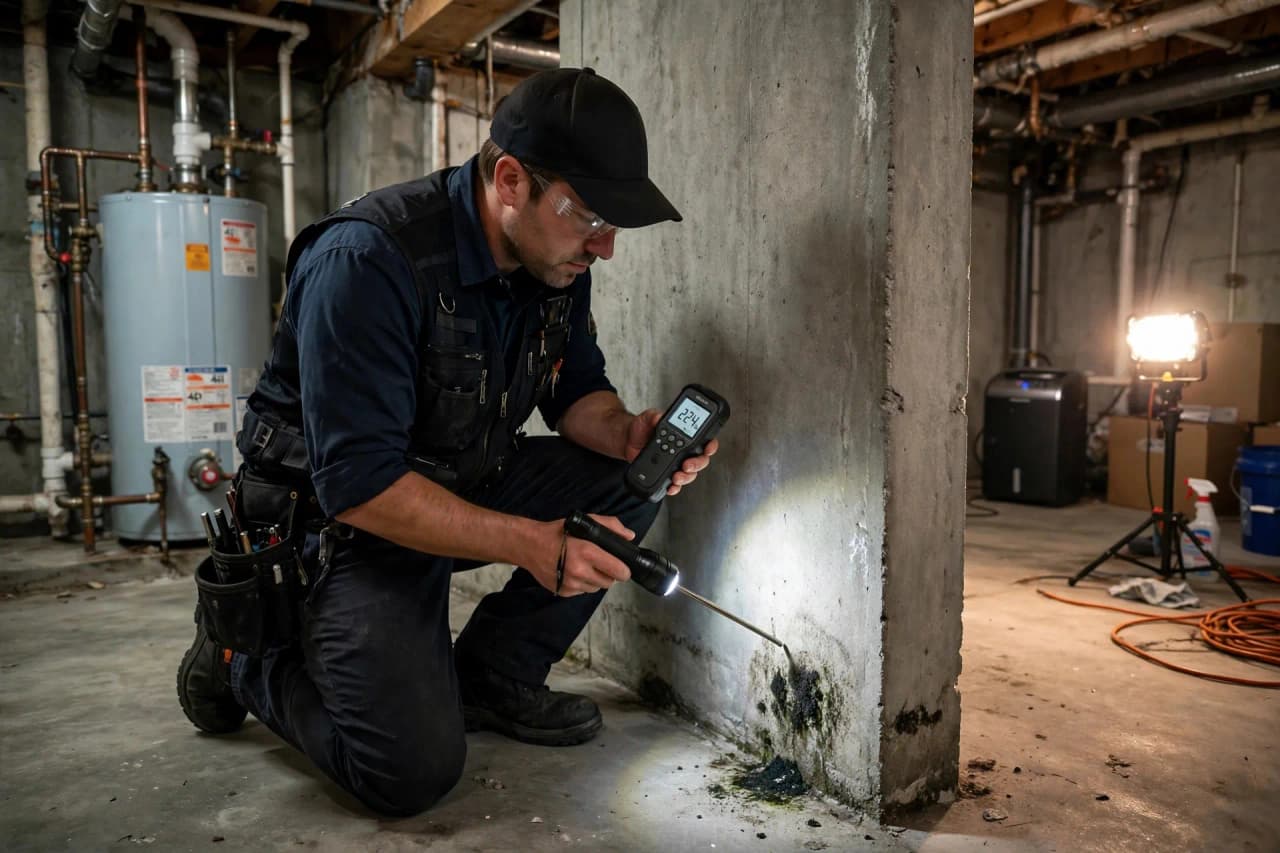
People use "mold testing" and "mold inspection" interchangeably, and the confusion costs homeowners real money. They are different services that answer different questions, and ordering the wrong one is like getting a blood test when what you needed was a physical exam. Related, but not the same.
Here is the simple version: an inspection finds the mold and figures out why it is there. Testing identifies what species it is and measures spore concentrations. Most homeowners need an inspection. Fewer need testing. Let us make sure you know which camp you are in before you spend a dime.
What a Mold Inspection Actually Involves
A professional mold inspection is a detective visit. A licensed assessor walks your property looking for visible growth, water intrusion, moisture problems, and conditions that invite mold. They bring tools you probably do not own: pin and pinless moisture meters that read dampness inside walls, thermal imaging cameras that reveal cold spots and hidden moisture patterns, and hygrometers that measure indoor humidity room by room.
The good ones also play historian. They ask about past leaks, flooding, roof issues, and plumbing repairs. They check the attic ventilation, the basement drainage, the grading around the foundation. Mold is a moisture problem wearing a costume, so a thorough inspector investigates the moisture story, not just the fuzzy spots.
What you get at the end is a written report: what was found, where, the likely moisture sources, and a recommended remediation scope. That report is the foundation everything else builds on. Quotes, insurance claims, real estate negotiations, they all start from a proper inspection. In New York, this must be done by a licensed mold assessor, and on remediation projects, the assessor has to be independent from the company doing the cleanup.
What Mold Testing Actually Involves
Mold testing means collecting samples and sending them to a laboratory. The most common types are air samples (a calibrated pump pulls air through a cassette for a set time, capturing airborne spores), surface samples (tape lifts or swabs of visible growth), and occasionally bulk samples (a piece of the actual material). The lab then identifies the species present and counts concentrations.
Air testing usually involves an outdoor control sample for comparison, because mold spores exist in all outdoor air and the question is whether indoor levels or species are abnormal relative to outside. Without that baseline, indoor numbers are meaningless. Any testing company that skips the outdoor control is cutting a corner that matters.
Results take a few days to a week. You get a lab report listing species found and spore counts, sometimes with a plain-English interpretation. What you do not automatically get is a plan. A lab report tells you what is floating around. It does not tell you where it is growing, why, or how to fix it. That is the inspection's job, which is why testing without inspection often leaves people holding expensive paper and no answers.
The Key Difference, Plainly Stated
Inspection answers: where is the mold, how bad is it, and what is causing it. Testing answers: what species are present and how many spores are in the air. One is about the building. The other is about the biology. You need the building answers before the biology answers mean anything.
Think of it this way. If you can see mold on your basement wall and the wall is damp from a foundation crack, you do not need a lab to tell you the species before acting. You need someone to scope the extent, specify the remediation, and make sure the water issue gets fixed. Testing would add cost without changing the plan one bit.
Where testing earns its keep is when the questions are genuinely biological or legal rather than practical. Is this Stachybotrys or a lookalike? Are indoor spore counts elevated compared to outdoors? Do I have documentation-grade evidence for a dispute? Those are testing questions. "What do I do about the mold in my wall" is an inspection question, and it is the question most homeowners are actually asking.
When Testing Is Worth the Money
Let us be specific about when to pay for testing, because it is not never. Post-remediation clearance testing, sometimes called a clearance test, verifies that a remediation job actually worked. An independent assessor takes air samples after cleanup and compares them to outdoor baselines. For large jobs, insurance claims, or just peace of mind, this is money well spent. It is the receipt that proves the work is done.
Real estate transactions are another legitimate case. Buyers sometimes want documented evidence of mold conditions before committing, and sellers occasionally want clearance documentation to reassure buyers after remediation. Paper trails smooth deals.
Health investigations and legal disputes round out the list. If a doctor is trying to understand an environmental exposure, or you are in a landlord-tenant dispute heading toward legal proceedings, lab documentation carries weight that visual observations do not. In these situations, testing is not optional. It is the evidence.
When Testing Is a Waste of Money
Here is our honest, possibly unpopular take: most residential testing sold to homeowners is unnecessary. If you can see the mold, you know you have mold. A lab report naming the species will not change the remediation plan, because pros remediate all indoor mold growth the same way. Paying $400 to learn the Latin name of the stuff on your drywall is trivia, not strategy.
The DIY petri-dish kits are the worst value of all. They will grow mold, because mold spores are literally everywhere, including in the air of spotless homes. A dish full of growth proves nothing except that biology exists. These kits cannot tell you whether you have a problem, where it is, or what to do. They are anxiety generators with a barcode.
Single air samples without an outdoor control are nearly as useless. Indoor spore counts mean nothing in isolation. And "mold inspectors" who lead with testing instead of a thorough visual and moisture investigation are often selling lab fees rather than answers. A proper assessment starts with the building, not the petri dish.
What Each One Costs in the Albany Area
A professional visual inspection with moisture investigation typically runs $200 to $400 in the Capital Region, depending on property size and complexity. Many remediation companies offer free visual estimates for straightforward jobs, which is fine for scoping but is not the same as an independent assessor's written report. Know which one you are getting.
Testing costs stack on top. A basic set of air samples with an outdoor control usually runs $300 to $600 through a licensed assessor using an accredited lab. Surface sample analysis is cheaper per sample but adds up. Full clearance testing after remediation falls in a similar range. None of this is outrageous, but it is real money, so spend it where it answers a question you actually have.
Watch out for package deals that bundle inspection and testing at inflated prices without explaining why both are needed. And remember the New York rule: the assessor who inspects and tests must be independent from the remediator who does the cleanup. If one company offers to do it all, that is not a convenience. That is a red flag under Article 32.
So Which Do You Need? A Decision Guide
You see visible mold and know roughly where the moisture is coming from: get an inspection (or a reputable free estimate for small jobs). The inspector scopes the work, you get it remediated, done. Testing adds nothing here.
You smell mold but cannot find it, or you are buying a home with moisture history: get an inspection with thermal imaging and moisture mapping. Finding hidden growth is detective work, and that is the inspector's specialty.
You need documentation for insurance, a real estate deal, or a legal matter: get an inspection plus targeted testing. The inspection provides context, the testing provides evidence. Together they are bulletproof.
The remediation is done and you want proof it worked: get independent clearance testing. This is the single highest-value use of testing for most homeowners.
Still unsure? That is exactly what Mold Removal Albany is for. We are a free referral service connecting you with independent, licensed local pros, including licensed assessors who will tell you honestly whether you need testing or just a good inspection. No upsell, no scare tactics, just the right service for your situation.